Thursday, 20 June 2019

Origin & Development of Jainism

Origin & Development of Jainism


Sixth century BC witnessed the rise of many religious movements in ancient India. People expressed their discontentment with the biased Varna system, priesthood and complex ritualistic sacrifices. It was against this background of exploitation of the masses and discrimination among people on the basis of Varna system that Mahavira and Buddha protested, resulting in rise and growth of liberal and inclusive religious sects in ancient India.
CAUSES FOR THE RISE AND GROWTH OF UNORTHODOX RELIGIOUS MOVEMENTS:

THE VARNA SYSTEM & THE DOMINATION OF PRIESTLY CLASS

The varna-divided society seems to have generated tensions during the sixth century B.C. The Kshatriyas who functioned as rulers, reacted strongly against the ritualistic domination of the brahmanas and seem to have led a kind of protest movement against the importance attached to the birth in the varna system. The kshatriya reaction against the domination of the priestly class called brahmanas, who claimed various privileges, was one of the causes of the origin of new religions.Buddha and Mahavira, both came from Kshatriya origin.

AGRICULTURAL ECONOMY & THE IRON PLOUGH-SHARE


The agricultural economy based on the iron plough share required the use of bullocks, and it could not flourish without animal husbandry. But the Vedic practice of killing cattle indiscriminately in sacrifices stood in the way of the progress of new agriculture. The newly emerging peasant communities who appear to have become dominant did not approve the killing of cattle in the sacrifice, as cattle wealth was very essential to supplement agricultural operations. The non-killing or Ahimsa preached by the heterodox sects appears to have made these social groups opt for the heterodox sects.
THE INCREASE IN TRADE AND COMMERCE
The increase in trade and commerce added to the importance of the vaishyas. The vaishyas being ranked third in the brahmanical society, looked for some religion which could improve their position. The patronage extended to trade and commerce in particular by Buddhism and Jainism made the merchants, rich and poor agriculturists and artisans to favour Buddhism and Jainism.
THE NEW FORMS OF PROPERTY
The new forms of property created social inequalities, and caused misery and suffering to the masses of the people. So the common people wished to return to primitive life. They wanted to get back to the ascetic ideal which dispensed with the new forms of property and the new style of life.
THE COMPLEX RITUALS AND SACRIFICES
The complex rituals and sacrifices advocated in the Later Vedic period were not acceptable to the common people. The sacrificial ceremonies were also found to be too expensive. The superstitious beliefs and mantrasconfused the people. The teachings of Upanishads, an alternative to the system of sacrifices, were highly philosophical in nature and therefore not easily understood by all. Therefore, what was needed in the larger interests of the people was a simple, short and intelligible way to salvation for all people. Such religious teaching should also be in a language known to them. This need was fulfilled by the teachings of Buddha andMahavira. The code of conduct prescribed for lay people by these new religions appeared to be more practical than performing protracted rites through the Brahmin priest.

THE ORIGIN OF JAINISM AND VARDHAMANA MAHAVIRA


The changing scenario of the socio-economic order of the 6th century BC led to the establishment of Jainism and Buddhism as heterodox sects later to be popularly known as reform movements. Jain tradition speaks of twenty-four Tirthankaras (prophets). In the Rigveda, there are references to Rishaba, the first Tirthankara as claimed by Jains.
Very little is known about the life of Parshva, the 23rdTirthankara. It is believed that he was the son of the King of Banaras who became an ascetic at the age of thirty, got enlightenment after 84 days of penance, gave his message to the people up to the age of 100 years and died in Bihar nearly 250 years before Mahavira.Vardhaman Mahavira was the 24th Tirthankara of Jainism. According to Jain tradition, most Tirthankaras were born in the mid-Gangetic basin and attained nirvana in Bihar.
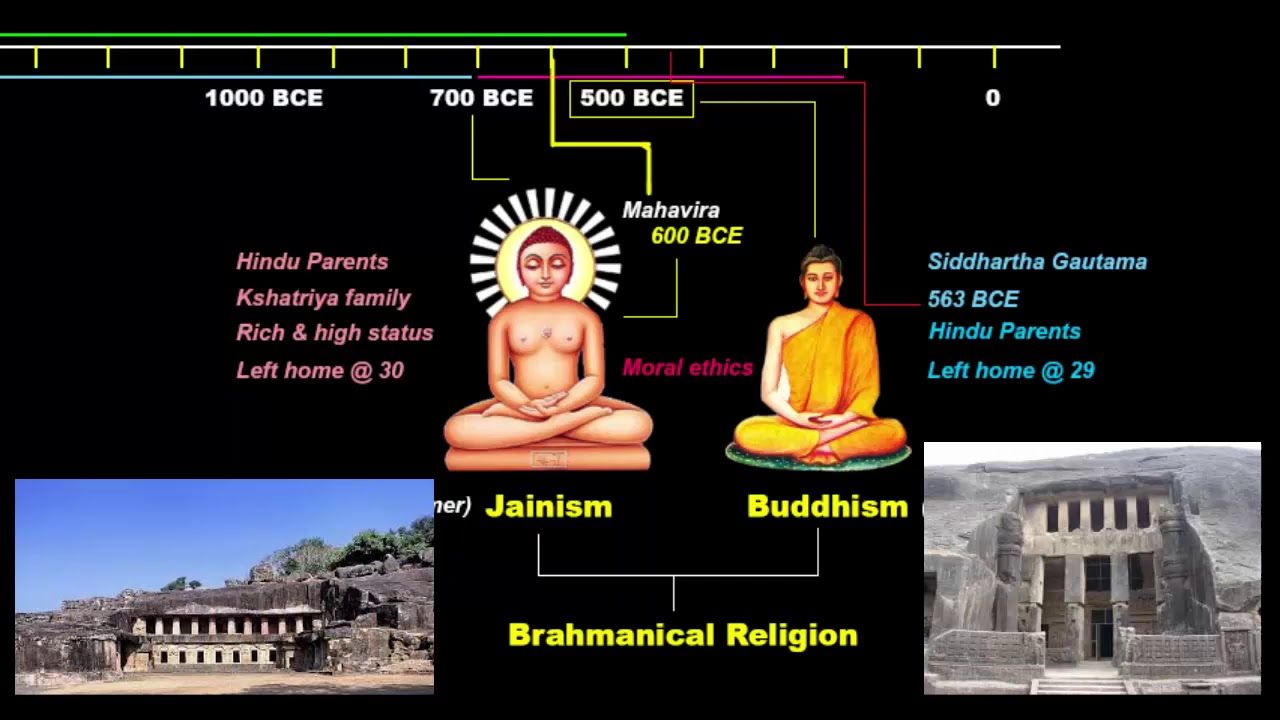
According to one tradition, Vardhaman Mahavira was born in 540 BC in a village near Vaishali. Being the son of Siddhartha, the head of a Kshatriya clan Jnatrika. Mahaviras mother was named Trishala, sister of the Lichchavi chief Chetaka whose daughter was wedded to Bimbisara hence he also had connections with the royal family of Magadha. Initially, Mahavira led the life of a householder but in his quest for truth, he abandoned the world at the age of 30 and became an ascetic.
After wandering from place to place for 12 years, he attained omniscience (Kaivalya) through which he conquered misery and happiness. Because of this conquest, he is known as Mahavira or the great hero or Jina that is the conqueror and his followers are known as Jainas. He propagated his religion for thirty years and his mission took him to Koshala, Magadha, Mithila, Champaetc. He passed away at the age of 72 in 468 BC at Pavapuri near modern Rajgir.
TEACHINGS OF MAHAVIRA


The most important idea in Jainism is that the entire world is animated:  even stones, rocks and water have life and they have soul. Non-injury to living beings, especially to humans, animals, plants and insects, is central to Jaina philosophy.  In fact, the principle of ahimsa, emphasised within Jainism, has left its mark on Indian thinking as a whole. According to Jaina teachings, the cycle of birth and rebirth is shaped through karma. 
Asceticism and penance are required to free oneself from the cycle of karma. This can be achieved only by renouncing the world; therefore, monastic existence is a necessary condition of salvation. Religious texts written inPali do not recognize Mahavira as an originator of a new religion but as a reformer of an existing religion. Mahavira accepted mostly the religious doctrines of Parshva but certainly made some alterations and additions to them.Parshva emphasized self –control and penance and advised his followers to observe Satya (truth), Ahimsa(non-violence), Aprigraha (no possession of property),Asteya (not to receive anything which is not freely given). To these Mahavira added Brahmacharya (celibacy).

FIVE DOCTRINES OF JAINISM

  1. Non- violence (ahimsa),
  2. No lies (satya),
  3. No stealing (asteya),
  4. No property (aparigraha), and
  5. Observing continence (brahmacharya).
The five principles or vows when observed by the monks strictly are known as ‘mahavratas’, but when lay members practice them they are called ‘anuvratas’.
THREE JEWELS OR TRIRATNA

The aim of Jain life is to achieve liberation of the soul. This is done by following the Jain ethical code, or to put it simply, living rightly by following the three jewels of Jain ethics. Three jewels or triratna are a metaphor for describing conduct and knowledge:
RIGHT FAITH

This doesn’t mean believing what you’re told, but means seeing (hearing, feeling, etc.) things properly, and avoiding preconceptions and superstitions that get in the way of seeing clearly. Belief in True Prophets (like Jain Tirthankars) True Scriptures (like Jain Shastras) and True Preceptors (like Jain saints).
RIGHT KNOWLEDGE

A person who has right knowledge will naturally free themselves from attachment and desire, and so achieve peace of mind. Right Knowledge is broadly divided into five categories:
  1. Sensory knowledge (Mati Gyan): knowledge derived through the sense organs like eyes, ears etc. and the mind. It can be false or right depending on the truth and rightness of the perception
  2. Study Knowledge (Srut Gyan): verbal or scriptural knowledge
  3. Remote Knowledge (Avadhi Gyan): determinate knowledge of remote physical objects derived directly without instrumentality of senses or mind.
  4. Mind Reading knowledge (Telepathy or Man Prayaya Gyan): All living beings with mind when engaged in thinking give different shapes to the mind according to objects thought of. The knowledge which can apprehend these shapes of other minds or thoughts of others is telepathy.
  5. Omniscience (Kewalya Gyan): This is unlimited knowledge of the whole of reality which the individual soul acquires directly. Once omniscience appears, the soul is all set for liberation.
RIGHT CONDUCT

This means living your life according to Jain ethical rules, to avoid doing harm to living things and freeing yourself from attachment and other impure attitudes and thoughts. Jains believe that a person who has right faithand right knowledge will be motivated and able to achieveright conduct.
JAIN PHILOSOPHY

As regards philosophy, Jaina philosophy shows a close affinity to Hindu Sankhya philosophy. It also ignores the idea of creator God, accepts that the world is full of sorrows and believes in the theory of Karma and transmigration of soul.  Jaina philosophy is that of dualism. It believes that human personality is formed of two elements: Jiva (soul) and Ajiva (matter).
While Ajiva is destructible, Jiva is indestructible and the salvation of an individual is possible through progress of Jiva. In short, the living and non-living (soul and matter) by coming into contact with each other create energies which cause birth, death and various experiences of life.These energies already created could be destroyed by a course of discipline leading to salvation or nirvana. This means seven things:
  1. There is something called the living.
  2. There is something called the non-living.
  3. The two come in contact with each other.
  4. The contact leads to production of energies.
  5. The process of contact could be stopped.
  6. The existing energies could be exhausted.
  7. Salvation could be achieved.
These seven propositions are called the seven tattvas or truths or realities by Jainas. On the basis of these propositions, Jaina philosophy states that if one desires to attain Nirvana, it is important for him to destroy Karma. One could gradually do it by avoiding evil Karma first and later other Karma. To equip himself for such a task a person should observe the five principles of the religion namely Satya, Ahimsa, Aprigraha, asteya and Brahamacharya. Jainism is essentially atheistic the concept of God being irrelevant. But it accepts a group of prophets or Tirthankaras who were deified men.
ANEKANTAVADA refers to the principles of pluralismand multiplicity of viewpoints, the notion that reality is perceived differently from diverse points of view, and that no single point of view is the complete truth, yet taken together they comprise the complete truth. It is one of the most important and fundamental doctrines of Jainism.
UNIVERSAL LAW Every mortal possesses the potentiality of becoming as great as they were. Jainism represents the universe as functioning according to eternal law continuously passing through a series of cosmic waves of progress and decline. According to it, the sole purpose of life is the purification of soul.
Unlike the Upnishads, Jainism preaches that the purification of soul cannot be attained through knowledge but only through rigorous ascetic punishment of the body thereby freeing the soul from the sorrows of life.
A monastic life was essential for full salvation. No lay jaina could take up the profession of agriculture since this involved not only the destruction of plant life but also of many living things in the soil. That is why strict limitation of private property enforced by Jainism was interpreted to mean only landed property. There was no restriction on amassing wealth by means of trade and commerce. The practice of nonviolence in Jainism had more of negativity since it lays greater emphasis on vegetarianism and precaution against killing of insects and animals rather than on loving them.
PRINCIPAL SECTS OF THE JAINISM

By the end of the fourth century B.C., there was a serious famine in the Ganges valley. Many Jain monks led byBhadrabagu and Chandragupta Maurya came to Sravana Belgola in Karnataka. Those who stayed back in north India were led by a monk named Sthulabahu who changed the code of conduct for the monks. This led to the division of Jainism into two sects Svetambaras(whiteclad) and Digambaras (Sky-clad or Naked). Digambar means those whose garment is only the four directions, or "sky-clad". 'Svet' means white and Svetambars are those who wear white coverings.
DIFFERENCES BETWEEN DIGAMBARAS AND SVETAMBARAS
Digambar Jain monks do not wear clothes because they believe clothes are like other possessions, increasing dependency and desire for material things, and desire for anything ultimately leads to sorrow.
Svetambar Jain monks wear white clothes for practical reasons and believe there is nothing in Jain scripture that condemns wearing clothes. These differing views arise from different interpretations of the same holy books.
Digambars believe that women cannot attain moksha in the same birth, while Svetambars believe that women may attain liberation and that Mallinath, a Tirthankar, wasfemale. The difference centres on the fact that Digambar ascetism requires nudity. As nudity is not practical for women, it follows that without it they cannot attain moksha.
Digambars believe that Mahavir was not married, whereas Shvetambars believe the princely Mahavir was married and had a daughter.
In the first Jain prayer, the Namokara Mantra. Sthanakavasis and Digambars believe that only the first five lines are formally part of the Namokara Mantra, whereas Svetambaras believe all nine form the mantra. Other differences are minor and not based on major points of doctrine.
JAIN COUNCILS & LITERATURE

In the first council at Pataliputra, the Jaina canon was divided into 12 sections which the Svetambaras accepted but Digambaras refused to accept this claiming that all old scriptures were lost. At the second council held at Vallabhi new additions were made in the form of‘Upangas’ or minor sections. Among the 12 angas the Acharayanga Sutta and the Bhagwati Sutta are the most important. While the former deals with the code of conduct which a Jaina monk is required to follow, the later expound the Jaina doctrines in a comprehensive manner. 
Teachings of Mahavira became very popular among the masses and different sections of society were attracted to it. One of the important causes for the success was the popular dialect (Prakrit) used in place of Sanskirt. The simple and homely morals prescribed to the masses attracted the people. The royal patronage by the rulers of Magadha later made Mathura and Ujjain great centres of Jainism. Jain councils collected the material of the sacred texts to write them down systematically, in Ardhamagadhi. But in the absence of popular religious preachers after the death of Mahavira, its division into two important sects, absence of protection by the later rulers, revival of Hinduism under the Guptas, Cholas, Chalukyasand Rajput kings also contributed to its slow decline.
JAIN CONTRIBUTION TO INDIAN CULTURE

Its contribution to Indian culture particularly literature, architecture and sculpture has been remarkable. Though the language of its religious texts had been Prakrit, it helped in giving a literary shape to some spoken languages of India. The temples and idols still existing in various cities as Mathura, Gwalior, Junagarh, Chittor, Abuhave been accepted as some of the best specimens of Indian architecture and sculpture particularly the temples of Abu, the Jaina tower at Chittorgarh, the elephant caves of Orissa and the 70 feet high idol of Bahubali in Mysore.
GROWTH OF ART AND ARCHITECTURE

Jainism helped a lot in the growth of Art and Architecture. The kings patronized Jainism. So many Jaina unages and the images of Jaina Tirthankara were found in many parts of India. The image of Bahuvalin in Shravanavelgola in Karnataka (known as Gomateswara) is the highest Jaina image ever craved in India. The Jaina images found in Mathura, Bundelkhand, Northem Madhya Pradesh, Orissa and Benares are important Jaina Art remains in India. The cave art of Udayagiri in Bhubaneswar, Madhya Pradesh, Ellora and Maharashtraare unique examples of Jaina art.
The Dilwara Jaina temple at Mount Abu of Rajasthan is a dream in marble. Nearly 90 percent of Jaina temples are the gifts of single wealthy individuals and as such the Jaina temples are distinguished for elaborate details and exquisite finish. The Jain Tower in the fort of Chittor is another specimen of architectural engineering. Innumerable manuscripts in palm leaves were written down and some of them were painted with gold dust. These have given rise to a new school of painting known as the “Western Indian School”. Thus, Jainism helped in the growth of art and architecture in India.

THE JAIN RITUAL-- SANTHARA

Santhara is a century old Jain ritual which implies facing death by a person voluntarily when he is nearing his end and when normal life according to religion is not possible due to old age, incurable disease, severe famine etc., after subjugation of all passions and abandonment of all worldly attachments, by observance of austerities, gradually quitting food and water, and by simultaneous meditation on the real nature the self, until the soul parts from the body. According to Jainism, it is a means for self-realization.
Recently, The Supreme Court has restored the Jain religious practice of a ritualistic fast unto death by staying an order of the Rajasthan High Court, which compared it to an act of suicide.
Sallekhana is not the destruction of life out of passions, nor it is motivated by any desire. on the other end, suicide is motivated by physical or psychological feelings of exhaustion, frustration, or both. Suicide is a desperate measure, triggered by failure and setbacks in life; it is an act of cowardice, a surrender to the circumstance because of lack of will power. According to the Jains,Santhara is the exact opposite of this.
In Jainism, the concept of choosing the manner and time of one’s death is a centuries-old ritual. The devout Jains believe that Mahavira, the 24th Tirthankar, allowed Santhara, or Sallekhana, as the ultimate test of spirituality, will power, whose ultimate goal is purifying body and mind and facing death voluntarily. Though both ultimately causes death, they carry huge difference as santhara practice is done in systematic way with full consciousness. For a religious culture that believes in rebirth, it certainly cannot be suicide. Further it is performed as an ethical act to attain moksha.
Misinterpretations and misunderstandings of such religious practices may often damage the ethics of society as whole taking in view the following points.
  1. The practice can also be a mean to over come economic hardships and other grave problems of life. It is very difficult to find out the real intention behind one's vow of Sallekhana or santhara.
  2. Recent reports show that women perform it than men that forces one to think that religious belief cannot be the sole reason behind it.
  3. Further, as suicide brings dishonor, individuals can take guise of such practice. It will also help them in earning admiration and worship.
  4. It will also motivate others to adopt the same which can never be in the interest of any society.
For a multi-religious country like India, it cannot be a good idea to abolish absolutely such religious practice but a proper counselling of the individual and understanding their psychological thinking can help in differentiating the real objective of such rituals. The Practice of Santhara is ethical as long as they do not violate any person's or family's freedom. It should not be forced on anyone in the guise of family / social pride and must be based on true devotion. Further the practice of Santhara shall be subjected to the test of rationality and its outcome should be implemented after proper consultation and involvement of the people following such religious ritual.

REASONS FOR THE DECLINE OF JAINISM

LACK OF ROYAL PATRONAGE

The royal patronage of Jainism by Bimbisara, Ajatasatru, Udayin and Kharavela was not kept up by kings and princes of later times. Rather the zeal and determination of Asoka, Kanishka and Harsha to spread Buddhism came to end Jainism. As such, lack of sincere and determined royal patronage came to cease Jainism.
SEVERITY OF JAINISM

The severity of Jainism is also responsible for its gradual decline. Unlike the ‘middle path’ of Buddhism, Jainism stood for severe penance, meditation, fasting and restraint etc. All these were too severe to endure. People soon became disillusioned with it. In course of time, Jainism, once adored, became alienated from the people.
UNINTELLIGIBLE PHILOSOPHY

Most of the Jaina philosophy was unintelligible for the masses. The concepts of Jeeva, Ajeeva, Pudgala, Syadbada etc. could not be understood properly by the people. Many could not accept the view that stone, water, tree or earth had a soul of their own. There was, thus, a gradual decline in popular faith for Jainism. This paved the way for its decline.
DIVISION IN JAINISM
Division among the Jainas after the death of Mahavira was the another important reason of the decline of Jainism. Some now advocated to literally follow the teachings of Mahavira, while others wanted to dilute the severity of Jainism. As such, the rift led to a division in Jain ranks. They were now divided into ‘Digamvara’ and ‘Swetamvara’ groups. The former, led by Bhadrabahu, gave up dress, adopted severe penance for self-purification and became indifferent to worldly life. The ‘Swetamvara’ group, led by Sitalabahu, wore white dress. The division weakened Jainism and gradually led to its decline.


Origin & Development of Jainism


Origin & Development of Jainism


Sixth century BC witnessed the rise of many religious movements in ancient India. People expressed their discontentment with the biased Varna system, priesthood and complex ritualistic sacrifices. It was against this background of exploitation of the masses and discrimination among people on the basis of Varna system that Mahavira and Buddha protested, resulting in rise and growth of liberal and inclusive religious sects in ancient India.
CAUSES FOR THE RISE AND GROWTH OF UNORTHODOX RELIGIOUS MOVEMENTS:

THE VARNA SYSTEM & THE DOMINATION OF PRIESTLY CLASS

The varna-divided society seems to have generated tensions during the sixth century B.C. The Kshatriyas who functioned as rulers, reacted strongly against the ritualistic domination of the brahmanas and seem to have led a kind of protest movement against the importance attached to the birth in the varna system. The kshatriya reaction against the domination of the priestly class called brahmanas, who claimed various privileges, was one of the causes of the origin of new religions.Buddha and Mahavira, both came from Kshatriya origin.

AGRICULTURAL ECONOMY & THE IRON PLOUGH-SHARE


The agricultural economy based on the iron plough share required the use of bullocks, and it could not flourish without animal husbandry. But the Vedic practice of killing cattle indiscriminately in sacrifices stood in the way of the progress of new agriculture. The newly emerging peasant communities who appear to have become dominant did not approve the killing of cattle in the sacrifice, as cattle wealth was very essential to supplement agricultural operations. The non-killing or Ahimsa preached by the heterodox sects appears to have made these social groups opt for the heterodox sects.
THE INCREASE IN TRADE AND COMMERCE
The increase in trade and commerce added to the importance of the vaishyas. The vaishyas being ranked third in the brahmanical society, looked for some religion which could improve their position. The patronage extended to trade and commerce in particular by Buddhism and Jainism made the merchants, rich and poor agriculturists and artisans to favour Buddhism and Jainism.
THE NEW FORMS OF PROPERTY
The new forms of property created social inequalities, and caused misery and suffering to the masses of the people. So the common people wished to return to primitive life. They wanted to get back to the ascetic ideal which dispensed with the new forms of property and the new style of life.
THE COMPLEX RITUALS AND SACRIFICES
The complex rituals and sacrifices advocated in the Later Vedic period were not acceptable to the common people. The sacrificial ceremonies were also found to be too expensive. The superstitious beliefs and mantrasconfused the people. The teachings of Upanishads, an alternative to the system of sacrifices, were highly philosophical in nature and therefore not easily understood by all. Therefore, what was needed in the larger interests of the people was a simple, short and intelligible way to salvation for all people. Such religious teaching should also be in a language known to them. This need was fulfilled by the teachings of Buddha andMahavira. The code of conduct prescribed for lay people by these new religions appeared to be more practical than performing protracted rites through the Brahmin priest.

THE ORIGIN OF JAINISM AND VARDHAMANA MAHAVIRA


The changing scenario of the socio-economic order of the 6th century BC led to the establishment of Jainism and Buddhism as heterodox sects later to be popularly known as reform movements. Jain tradition speaks of twenty-four Tirthankaras (prophets). In the Rigveda, there are references to Rishaba, the first Tirthankara as claimed by Jains.
Very little is known about the life of Parshva, the 23rdTirthankara. It is believed that he was the son of the King of Banaras who became an ascetic at the age of thirty, got enlightenment after 84 days of penance, gave his message to the people up to the age of 100 years and died in Bihar nearly 250 years before Mahavira.Vardhaman Mahavira was the 24th Tirthankara of Jainism. According to Jain tradition, most Tirthankaras were born in the mid-Gangetic basin and attained nirvana in Bihar.
According to one tradition, Vardhaman Mahavira was born in 540 BC in a village near Vaishali. Being the son of Siddhartha, the head of a Kshatriya clan Jnatrika. Mahaviras mother was named Trishala, sister of the Lichchavi chief Chetaka whose daughter was wedded to Bimbisara hence he also had connections with the royal family of Magadha. Initially, Mahavira led the life of a householder but in his quest for truth, he abandoned the world at the age of 30 and became an ascetic.
After wandering from place to place for 12 years, he attained omniscience (Kaivalya) through which he conquered misery and happiness. Because of this conquest, he is known as Mahavira or the great hero or Jina that is the conqueror and his followers are known as Jainas. He propagated his religion for thirty years and his mission took him to Koshala, Magadha, Mithila, Champaetc. He passed away at the age of 72 in 468 BC at Pavapuri near modern Rajgir.
TEACHINGS OF MAHAVIRA


The most important idea in Jainism is that the entire world is animated:  even stones, rocks and water have life and they have soul. Non-injury to living beings, especially to humans, animals, plants and insects, is central to Jaina philosophy.  In fact, the principle of ahimsa, emphasised within Jainism, has left its mark on Indian thinking as a whole. According to Jaina teachings, the cycle of birth and rebirth is shaped through karma. 
Asceticism and penance are required to free oneself from the cycle of karma. This can be achieved only by renouncing the world; therefore, monastic existence is a necessary condition of salvation. Religious texts written inPali do not recognize Mahavira as an originator of a new religion but as a reformer of an existing religion. Mahavira accepted mostly the religious doctrines of Parshva but certainly made some alterations and additions to them.Parshva emphasized self –control and penance and advised his followers to observe Satya (truth), Ahimsa(non-violence), Aprigraha (no possession of property),Asteya (not to receive anything which is not freely given). To these Mahavira added Brahmacharya (celibacy).

FIVE DOCTRINES OF JAINISM

  1. Non- violence (ahimsa),
  2. No lies (satya),
  3. No stealing (asteya),
  4. No property (aparigraha), and
  5. Observing continence (brahmacharya).
The five principles or vows when observed by the monks strictly are known as ‘mahavratas’, but when lay members practice them they are called ‘anuvratas’.
THREE JEWELS OR TRIRATNA

The aim of Jain life is to achieve liberation of the soul. This is done by following the Jain ethical code, or to put it simply, living rightly by following the three jewels of Jain ethics. Three jewels or triratna are a metaphor for describing conduct and knowledge:
RIGHT FAITH

This doesn’t mean believing what you’re told, but means seeing (hearing, feeling, etc.) things properly, and avoiding preconceptions and superstitions that get in the way of seeing clearly. Belief in True Prophets (like Jain Tirthankars) True Scriptures (like Jain Shastras) and True Preceptors (like Jain saints).
RIGHT KNOWLEDGE

A person who has right knowledge will naturally free themselves from attachment and desire, and so achieve peace of mind. Right Knowledge is broadly divided into five categories:
  1. Sensory knowledge (Mati Gyan): knowledge derived through the sense organs like eyes, ears etc. and the mind. It can be false or right depending on the truth and rightness of the perception
  2. Study Knowledge (Srut Gyan): verbal or scriptural knowledge
  3. Remote Knowledge (Avadhi Gyan): determinate knowledge of remote physical objects derived directly without instrumentality of senses or mind.
  4. Mind Reading knowledge (Telepathy or Man Prayaya Gyan): All living beings with mind when engaged in thinking give different shapes to the mind according to objects thought of. The knowledge which can apprehend these shapes of other minds or thoughts of others is telepathy.
  5. Omniscience (Kewalya Gyan): This is unlimited knowledge of the whole of reality which the individual soul acquires directly. Once omniscience appears, the soul is all set for liberation.
RIGHT CONDUCT

This means living your life according to Jain ethical rules, to avoid doing harm to living things and freeing yourself from attachment and other impure attitudes and thoughts. Jains believe that a person who has right faithand right knowledge will be motivated and able to achieveright conduct.
JAIN PHILOSOPHY

As regards philosophy, Jaina philosophy shows a close affinity to Hindu Sankhya philosophy. It also ignores the idea of creator God, accepts that the world is full of sorrows and believes in the theory of Karma and transmigration of soul.  Jaina philosophy is that of dualism. It believes that human personality is formed of two elements: Jiva (soul) and Ajiva (matter).
While Ajiva is destructible, Jiva is indestructible and the salvation of an individual is possible through progress of Jiva. In short, the living and non-living (soul and matter) by coming into contact with each other create energies which cause birth, death and various experiences of life.These energies already created could be destroyed by a course of discipline leading to salvation or nirvana. This means seven things:
  1. There is something called the living.
  2. There is something called the non-living.
  3. The two come in contact with each other.
  4. The contact leads to production of energies.
  5. The process of contact could be stopped.
  6. The existing energies could be exhausted.
  7. Salvation could be achieved.
These seven propositions are called the seven tattvas or truths or realities by Jainas. On the basis of these propositions, Jaina philosophy states that if one desires to attain Nirvana, it is important for him to destroy Karma. One could gradually do it by avoiding evil Karma first and later other Karma. To equip himself for such a task a person should observe the five principles of the religion namely Satya, Ahimsa, Aprigraha, asteya and Brahamacharya. Jainism is essentially atheistic the concept of God being irrelevant. But it accepts a group of prophets or Tirthankaras who were deified men.
ANEKANTAVADA refers to the principles of pluralismand multiplicity of viewpoints, the notion that reality is perceived differently from diverse points of view, and that no single point of view is the complete truth, yet taken together they comprise the complete truth. It is one of the most important and fundamental doctrines of Jainism.
UNIVERSAL LAW Every mortal possesses the potentiality of becoming as great as they were. Jainism represents the universe as functioning according to eternal law continuously passing through a series of cosmic waves of progress and decline. According to it, the sole purpose of life is the purification of soul.
Unlike the Upnishads, Jainism preaches that the purification of soul cannot be attained through knowledge but only through rigorous ascetic punishment of the body thereby freeing the soul from the sorrows of life.
A monastic life was essential for full salvation. No lay jaina could take up the profession of agriculture since this involved not only the destruction of plant life but also of many living things in the soil. That is why strict limitation of private property enforced by Jainism was interpreted to mean only landed property. There was no restriction on amassing wealth by means of trade and commerce. The practice of nonviolence in Jainism had more of negativity since it lays greater emphasis on vegetarianism and precaution against killing of insects and animals rather than on loving them.
PRINCIPAL SECTS OF THE JAINISM

By the end of the fourth century B.C., there was a serious famine in the Ganges valley. Many Jain monks led byBhadrabagu and Chandragupta Maurya came to Sravana Belgola in Karnataka. Those who stayed back in north India were led by a monk named Sthulabahu who changed the code of conduct for the monks. This led to the division of Jainism into two sects Svetambaras(whiteclad) and Digambaras (Sky-clad or Naked). Digambar means those whose garment is only the four directions, or "sky-clad". 'Svet' means white and Svetambars are those who wear white coverings.
DIFFERENCES BETWEEN DIGAMBARAS AND SVETAMBARAS
Digambar Jain monks do not wear clothes because they believe clothes are like other possessions, increasing dependency and desire for material things, and desire for anything ultimately leads to sorrow.
Svetambar Jain monks wear white clothes for practical reasons and believe there is nothing in Jain scripture that condemns wearing clothes. These differing views arise from different interpretations of the same holy books.
Digambars believe that women cannot attain moksha in the same birth, while Svetambars believe that women may attain liberation and that Mallinath, a Tirthankar, wasfemale. The difference centres on the fact that Digambar ascetism requires nudity. As nudity is not practical for women, it follows that without it they cannot attain moksha.
Digambars believe that Mahavir was not married, whereas Shvetambars believe the princely Mahavir was married and had a daughter.
In the first Jain prayer, the Namokara Mantra. Sthanakavasis and Digambars believe that only the first five lines are formally part of the Namokara Mantra, whereas Svetambaras believe all nine form the mantra. Other differences are minor and not based on major points of doctrine.
JAIN COUNCILS & LITERATURE

In the first council at Pataliputra, the Jaina canon was divided into 12 sections which the Svetambaras accepted but Digambaras refused to accept this claiming that all old scriptures were lost. At the second council held at Vallabhi new additions were made in the form of‘Upangas’ or minor sections. Among the 12 angas the Acharayanga Sutta and the Bhagwati Sutta are the most important. While the former deals with the code of conduct which a Jaina monk is required to follow, the later expound the Jaina doctrines in a comprehensive manner. 
Teachings of Mahavira became very popular among the masses and different sections of society were attracted to it. One of the important causes for the success was the popular dialect (Prakrit) used in place of Sanskirt. The simple and homely morals prescribed to the masses attracted the people. The royal patronage by the rulers of Magadha later made Mathura and Ujjain great centres of Jainism. Jain councils collected the material of the sacred texts to write them down systematically, in Ardhamagadhi. But in the absence of popular religious preachers after the death of Mahavira, its division into two important sects, absence of protection by the later rulers, revival of Hinduism under the Guptas, Cholas, Chalukyasand Rajput kings also contributed to its slow decline.
JAIN CONTRIBUTION TO INDIAN CULTURE

Its contribution to Indian culture particularly literature, architecture and sculpture has been remarkable. Though the language of its religious texts had been Prakrit, it helped in giving a literary shape to some spoken languages of India. The temples and idols still existing in various cities as Mathura, Gwalior, Junagarh, Chittor, Abuhave been accepted as some of the best specimens of Indian architecture and sculpture particularly the temples of Abu, the Jaina tower at Chittorgarh, the elephant caves of Orissa and the 70 feet high idol of Bahubali in Mysore.
GROWTH OF ART AND ARCHITECTURE

Jainism helped a lot in the growth of Art and Architecture. The kings patronized Jainism. So many Jaina unages and the images of Jaina Tirthankara were found in many parts of India. The image of Bahuvalin in Shravanavelgola in Karnataka (known as Gomateswara) is the highest Jaina image ever craved in India. The Jaina images found in Mathura, Bundelkhand, Northem Madhya Pradesh, Orissa and Benares are important Jaina Art remains in India. The cave art of Udayagiri in Bhubaneswar, Madhya Pradesh, Ellora and Maharashtraare unique examples of Jaina art.
The Dilwara Jaina temple at Mount Abu of Rajasthan is a dream in marble. Nearly 90 percent of Jaina temples are the gifts of single wealthy individuals and as such the Jaina temples are distinguished for elaborate details and exquisite finish. The Jain Tower in the fort of Chittor is another specimen of architectural engineering. Innumerable manuscripts in palm leaves were written down and some of them were painted with gold dust. These have given rise to a new school of painting known as the “Western Indian School”. Thus, Jainism helped in the growth of art and architecture in India.

THE JAIN RITUAL-- SANTHARA

Santhara is a century old Jain ritual which implies facing death by a person voluntarily when he is nearing his end and when normal life according to religion is not possible due to old age, incurable disease, severe famine etc., after subjugation of all passions and abandonment of all worldly attachments, by observance of austerities, gradually quitting food and water, and by simultaneous meditation on the real nature the self, until the soul parts from the body. According to Jainism, it is a means for self-realization.
Recently, The Supreme Court has restored the Jain religious practice of a ritualistic fast unto death by staying an order of the Rajasthan High Court, which compared it to an act of suicide.
Sallekhana is not the destruction of life out of passions, nor it is motivated by any desire. on the other end, suicide is motivated by physical or psychological feelings of exhaustion, frustration, or both. Suicide is a desperate measure, triggered by failure and setbacks in life; it is an act of cowardice, a surrender to the circumstance because of lack of will power. According to the Jains,Santhara is the exact opposite of this.
In Jainism, the concept of choosing the manner and time of one’s death is a centuries-old ritual. The devout Jains believe that Mahavira, the 24th Tirthankar, allowed Santhara, or Sallekhana, as the ultimate test of spirituality, will power, whose ultimate goal is purifying body and mind and facing death voluntarily. Though both ultimately causes death, they carry huge difference as santhara practice is done in systematic way with full consciousness. For a religious culture that believes in rebirth, it certainly cannot be suicide. Further it is performed as an ethical act to attain moksha.
Misinterpretations and misunderstandings of such religious practices may often damage the ethics of society as whole taking in view the following points.
  1. The practice can also be a mean to over come economic hardships and other grave problems of life. It is very difficult to find out the real intention behind one's vow of Sallekhana or santhara.
  2. Recent reports show that women perform it than men that forces one to think that religious belief cannot be the sole reason behind it.
  3. Further, as suicide brings dishonor, individuals can take guise of such practice. It will also help them in earning admiration and worship.
  4. It will also motivate others to adopt the same which can never be in the interest of any society.
For a multi-religious country like India, it cannot be a good idea to abolish absolutely such religious practice but a proper counselling of the individual and understanding their psychological thinking can help in differentiating the real objective of such rituals. The Practice of Santhara is ethical as long as they do not violate any person's or family's freedom. It should not be forced on anyone in the guise of family / social pride and must be based on true devotion. Further the practice of Santhara shall be subjected to the test of rationality and its outcome should be implemented after proper consultation and involvement of the people following such religious ritual.

REASONS FOR THE DECLINE OF JAINISM

LACK OF ROYAL PATRONAGE

The royal patronage of Jainism by Bimbisara, Ajatasatru, Udayin and Kharavela was not kept up by kings and princes of later times. Rather the zeal and determination of Asoka, Kanishka and Harsha to spread Buddhism came to end Jainism. As such, lack of sincere and determined royal patronage came to cease Jainism.
SEVERITY OF JAINISM

The severity of Jainism is also responsible for its gradual decline. Unlike the ‘middle path’ of Buddhism, Jainism stood for severe penance, meditation, fasting and restraint etc. All these were too severe to endure. People soon became disillusioned with it. In course of time, Jainism, once adored, became alienated from the people.
UNINTELLIGIBLE PHILOSOPHY

Most of the Jaina philosophy was unintelligible for the masses. The concepts of Jeeva, Ajeeva, Pudgala, Syadbada etc. could not be understood properly by the people. Many could not accept the view that stone, water, tree or earth had a soul of their own. There was, thus, a gradual decline in popular faith for Jainism. This paved the way for its decline.
DIVISION IN JAINISM
Division among the Jainas after the death of Mahavira was the another important reason of the decline of Jainism. Some now advocated to literally follow the teachings of Mahavira, while others wanted to dilute the severity of Jainism. As such, the rift led to a division in Jain ranks. They were now divided into ‘Digamvara’ and ‘Swetamvara’ groups. The former, led by Bhadrabahu, gave up dress, adopted severe penance for self-purification and became indifferent to worldly life. The ‘Swetamvara’ group, led by Sitalabahu, wore white dress. The division weakened Jainism and gradually led to its decline.


Knowing about VEDIC PERIOD & CULTURE

Knowing about VEDIC PERIOD & CULTURE 


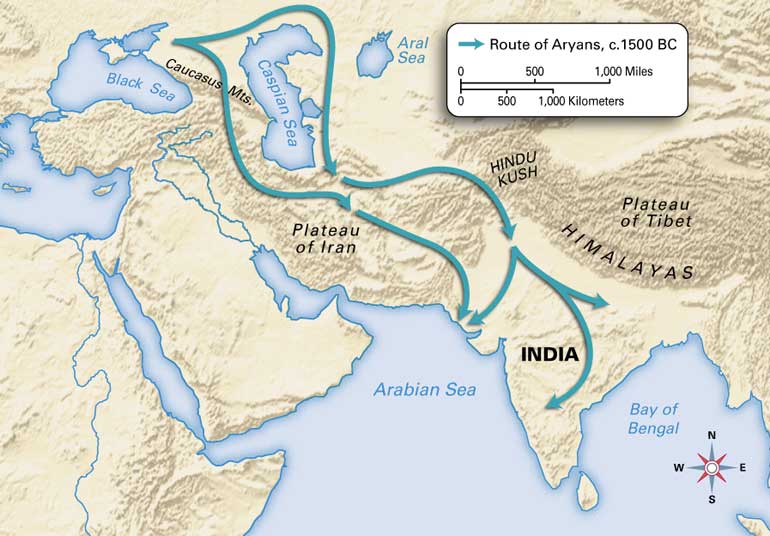
The cities of the Harappan Culture had declined by 1500 BC. Consequently, their economic and administrative system had slowly declined. Around this period, the Aryans entered the north-west India probably from the Indo-Iranian region. The word ‘Arya’ means ‘noble’.

 Aryans migrated to India in several waves through the passes in the northwestern mountains. Their earliest life seems to have been mainly pastoral, agriculture being a secondary occupation. We know about the Aryans from the Rig Veda. Aryan names also appear in Kassite inscriptions of about 1600 BC from Iraq and in Mitanni inscriptions of the 14th century BC from Syria.

 They initially settled in the valleys of the north-west and the plains of the Punjab. Later, they moved into Indo-Gangetic plains. They led a nomadic life and were mainly in search of pastures. By 6th century BC, they occupied the whole of North India, which was referred to as Aryavarta.

The period between 1500 BC and 600 BC may be divided into- 

  •  The Early Vedic Period or Rig Vedic Period (1500 BC–1000 BC) 
  •  The Later Vedic Period (1000 BC–600 BC)
Original Home of the Aryans

 The original home of the Aryans is a debatable question and different scholars have identified different regions as the original home of the Aryans.


  •   Some historians say that the original home of the Aryans was Central Asia. 
  • A c c o r d i n g t o B a l Gangadhar Tilak, Aryans originally inhabited Siberia but due to the falling temperature, they had to leave Siberia for greener pastures.
  •  The other view is that their original home was in southern Russia (near the Caspian Sea) or in the south-east Europe (in Austria and Hungary). From there, they had migrated to the European countries, Persia and India.
However, the theory of southern Russia appears to be more probable and widely accepted by historians. From there, the Aryans moved to different parts of Asia and Europe. They entered India in about 1500 BC and came to be known as Indo-Aryans. They spoke the Indo-Aryan language, Sanskrit. 

Tribal Conflicts

The first group of Aryans fought against the Dravidians and other inhabitants whom they defeated and are supposed to have been pushed down towards south India. The enemies were described by Aryans as Panis and Dasas. The Panis were cattle-thieves. Dasas were held to be inferior because of their dark skin and flat facial features. The word Dasa later came to denote a slave.

The term dasyuhatya (slaughter of the dasyus) is repeatedly mentioned in the Rig Veda. However, the Aryans also fought among themselves and thus many intra-tribal conflicts were common among the Aryan communities. 

The country, Bharatvarsha is named after the Bharata tribe, which is mentioned in the Rig Veda. The famous Battle of Ten Kings or the Dasrajan Yudha was fought between the tribe Bharatas, led by king Sudas and the Confederacy of other ten tribes – Puru, Yadu, Turvasa, Anu, Druhyu, Alina, Paktha, Bhalanas, Shiva and Vishanin. The former five are said to be Aryan tribes while the later five are said to be Non-Aryan tribes. The Bharatas emerged victorious in the battle which was fought on the banks of river Parushni (present Ravi). 
Vedic Literature

The word ‘Veda’ is derived from the root ‘vid’, which means ‘to know’. In other words, the term ‘Veda’ signifies wisdom, knowledge or vision. There are four Vedas and Rig Veda was composed in the early Vedic period while the other three Vedas were written in the later Vedic period.


Four Vedas

  • The Rig Veda is the earliest of the four Vedas and it consists of ten mandalas or books and 1028 hymns. The hymns were sung in praise of Agni, Indra, Mitra, Varuna and other Gods. It contains the famous Purushasukta that explains that the four varnas i. e. Brahmana, Kshatriya, Vaishya and Shudra were born respectively from the mouth, arms, thighs and the feet of the Creator. The universally famous Gayatri mantra (Savitri) is also in Rig-Veda. 

  • The Yajur Veda consists of not only hymns but also rituals that have to accompany their recitation. Various details of rules to be observed at the time of sacrifice are mentioned in this Veda. The rituals reflect the social and political milieu in which they arose. There are two main texts of the Yajurveda: Shukla Yajurveda or Vajasaneyi (Madhyandina and Kanva) and Krishna-Yajurveda (Taittiriya, Kathaka, Maitrayani and Kapisthal).

  •  The Sama Veda is a collection of melodies. It contains stanzas taken from Rig Veda and set to the tune for the purpose of singing. Samaveda is important in tracing the history of Indian music. 

  • The Atharva Veda contains details of rituals. It also contains charms and spells to ward off evils and diseases. The content of this Veda also throw light on the beliefs and practices of the non-Aryans.  
Besides the Vedas, there are other sacred works like the Brahmanas, the Upanishads, the Aranyakas and the epics Ramayana and Mahabharata. 

  • The Brahmanas explain the hymns of the Vedas. They act as the appendices to the Vedas. They are written in prose and they elaborately describe the various sacrifices and rituals, along with their mystic meanings. Each Veda has several Brahmanas. The two Brahmanas attached to the Rig-Veda are Aitareya Brahmana and Kaushitaki Brahmana.
  •  The Aranyakas are called forest books and they deal with mysticism, rites, rituals and sacrifices. They deal with mysticism and symbolism. They form the natural transition to the Upanishads. They offer the bridge between Karma marga (way of deeds) which was the sole concern of the Brahmanas and the jnana marga (way of knowledge) which the Upanishads advocated. 
  • The Upanishads are philosophical texts dealing with topics like the soul, the absolute, the origin of the world and the mysteries of nature. It criticizes the rituals and lay stresses on the value of right belief and knowledge. The language of Upanishads was classical Sanskrit and not the vedic Sanskrit. It states that goal of the life is to attain salvation which is possible through self control. 
  • An epic is a long poetry narrating the deeds and adventures of heroic or legendary figures. The author of epics of Ramayana and Mahabharata was Valmiki and Veda Vyasa respectively. 
Rig Vedic Age or Early Vedic Period (1500–1000 BC)

 During the Rig Vedic period, the Aryans were mostly confined to the Indus region. The Rig Veda refers to Saptasindhu or the land of seven rivers. This includes the five rivers of Punjab, namely Jhelum, Chenab, Ravi, Beas and Sutlej along with the Indus and Saraswati. The political, social and cultural life of the Rig Vedic people can be traced from the hymns of the Rig Veda

Political Organization 

Early vedic age had a tribal polity in which the tribal chief led wars (for cattle) and was also a protector of the entire group. Instead of a standing army, the entire village participated in wars. Kingship was hereditary. The king or the chief enjoyed a position of pre-eminence in the tribe. He was required to be ‘Indra’ in valour, ‘Mitra’ in kindness and ‘Varuna’ in virtues. 

Administrative Divisions 
  • The lowest unit of the Rig-Vedic society was the patriarchal family or kula. A number of families bound together by kinship ties of blood formed a clan. 
  • The ‘grama’ consisted of several families. It was under a headman known as ‘gramani’. Several villagers formed a ‘vis’. It was placed under a ‘visapati’. He was a military leader.
  •  A group of ‘vishes’ formed a ‘jana' (tribe) whose members were bound together by real or supposed ties of kinship. ‘Gopa’ was the head of one ‘jana’.
  •  Several janas formed a ‘janapada’ or ‘kingdom’. The ‘Rajan’ or the king was the head of the Janapada. There were several tribal kingdoms during the Rig Vedic period such as Bharatas, Matsyas, Yadus and Purus. 

Administration The tribal chief or the Rajan was at the centre of the administrative machinery of the Aryans. In the work of administration, the king was assisted by a number of functionaries like the Purohita (priest), the Senani (General of the Army), the Gramani (village headman) and the spsa (spies). Purohita was the most important officer of the state. 

  • The king did not maintain any regular or standing army but during times of war he mustered militias. The military element was strong in the tribal system of the government. The army mainly consisted of Patti (infantry) and Rathins (chariot warriors). The weapons used by the soldiers were bows, arrows, swords, axes and spears. These weapons were made up of irons. The soldiers were organised into units known as Sardha, Vrata and Gana. 
  • We do not come across any officer responsible for tax collection. There was very limited role for collection of regular tax as economy was mainly pastoral and not food producing. 
  • However bali, the voluntary offerings from the people, was probably received by the chiefs. Presents and spoils of war were perhaps distributed among some Vedic assemblies.
  •  There was no special officer for justice. But spies were employed to keep an eye on theft or burglary. 

NOTE

Vasishtha and Vishvamitra were the two impotant priests in Rig Vedic age. The former was conservative while the later was liberal. Vishwamitra composed the Gayatri Mantra to widen the Aryan World. 

Popular Assemblies 

The Aryans had their own folk assembly known as Vidhata meant for the economic, social and military purpose. Though the king enjoyed substantial power, yet he was not an autocrat. In the work of administration, he consulted two bodies and acted according to their decision. 
These were-

  •  Sabha – It was a select body of elders and advised the king on administration. It also functioned as a court of law and tried criminal cases. The head of the sabha was known as ‘Sabhapati’. 
  • Samiti – It was the most popular assembly and included common people. The Samiti mainly dealt with the political business of the state. It also used to elect the king. The head of Samiti was known as ‘Pati’.
  • Vrajapati was the officer who enjoyed authority over a large land or pasture ground. He led Gramanis to the battle. Gradually Gramani became identical to Vrajapati. 

Social Life

 Society

  •  Kinship was the basis of the social structure and the identity of man was decided by his clan. People gave their primary loyalty to the tribe or jana. 
  • There are indications which point towards the consciousness of physical appearance among the people. Varna was the term used for colour which provided the identity mark for the social orders. Rig Veda mentions arya and dasa varna. 
  • It seems that Aryan people were fair in colour while the indigenous population were dark. The dasas and the dasyus conquered by the Aryans, were treated as slaves. 
  • Slaves and mainly women slaves meant for domestic purposes, were given as gifts to priests. 
  •  Social inequality in the tribes emerged as tribal chiefs and the priests acquired a large share of booty at the cost of their kinsmen. Gradually, the society came to be divided into three groups – warriors, priests and the people.
  •  However, differentiation of society based on occupation was not very sharp. The society was largely tribal and egalitarian.

Family 

  •  The family was patriarchal and was regarded as the social and the political unit. The father was the head of the family and he was known as “grihapati”. 
  •  Monogamy was generally practiced while polygamy was prevalent among the royal and noble families. There are few indications of polyandry. There are also indications of matrilineal traces. The wife took care of the household and participated in all the major ceremonies.
  •  Women were given equal opportunities as men for their spiritual and intellectual development. There were women poets like Apala, Viswavara, Ghosa and Lopamudra during the Rig Vedic period. 
  •  Women could even attend the popular assemblies. There was no child marriage and the practice of sati was absent. The marriageable age seems to have been 16 to 17. 
  •  Women could offer sacrifices along with their husbands. 
  •  Widow remarriage and the practice of levirate was present in the Rig Vedic society. 

Clothing 

  • The Aryans wore dresses made from cotton, wool and deer skin. 
  •  The garments consisted of three parts—an undergarment called ‘nivi’, a garment called ‘Vasa’ or ‘Paridhan’ and a mantle known as ‘adhivasa’. 
  • Both men and women wore gold ornaments. The women used ear-rings, neck-lace, bangles and anklets.
Food 

  •  Wheat and barley, milk and its products like curd and ghee, vegetables and fruits were the chief articles of food. 
  • Fish, birds, goats, rams, bulls and horses were slaughtered for their food. 
  • Slaughter of cow was prohibited since it was considered a sacred animal. People also drank intoxicating liquor, “sura”. Caste System 
  • In the early Vedic age there was no caste system. Instead, they were divided into classes. 
  • Member of same family could pursue different occupations, arts, crafts and trades and could change it at will. There was hardly any restriction in intermarriage and change of occupation.
Education 
  • There were Gurukulas which imparted education to the disciples after their sacred thread ceremony. Entire instruction was given orally. 26 Ancient India 
  • The disciples were taught about ethics, art of warfare, art of metal and concept of Brahma and philosophy, and basic sciences like agriculture, animal husbandry, and handicrafts. 

Economic Condition

 The Aryans did not live in cities but possibly in a kind of fortified mud settlements. Painted Grey Ware has been found in the Bhagwanpura and other sites in Punjab, along with late Harappan pottery. 

Agriculture 

The Rig Vedic Aryans were pastoral people but when they permanently settled in North India, they began to practice agriculture. They ploughed the land by means of pair of oxen. The ploughed land was known as Urvara or Kshetra. With the knowledge and use of iron, they were able to clean forests and bring more lands under cultivation. However, land did not form a well established private property. 

  •  Besides the main crops of barley and wheat, cotton and oil seeds were also grown. 
  •  Cows were worshipped and were symbols of wealth and prosperity. Sometimes cow was the medium of exchange. The wealth of the people was estimated in terms of their cattle. The cow seems to be their most valuable possession and the wars were fought for the sake of cows. 
  • Other animals like horse, draught ox, dog, goat, sheep, buffalo and donkey were also domesticated. 
Crafts 
  • Weaving was an important occupation. 
  • Carpentry was another important profession and the availability of wood from the forests cleared made the profession profitable. Carpenters produced chariots and ploughs.
  • Workers in metal made a variety of articles with copper, bronze and iron. 
  • Spinning was another important occupation and cotton and woollen fabrics were made. 
  • Goldsmiths were active in making ornaments. 
  • The potters made various kinds of vessels for domestic use. 
Trade and Commerce 

Trade was conducted through barter system. There were trade and maritime activities. Sometimes traders made journey to distant lands for larger profits in trade. Cow was used as unit of value. Gradually pieces of gold called “nishka” were used as means of exchange. Trade and commerce was regulated and managed by a group of people called “Pani”.

 Transport

 Rivers served an important means of transport. The chief means of transport by land were rathas (Chariots) and wagons drawn by horses and oxen. Religion Gods 

  •  The religious life of the Rig Vedic Aryans was simple and plain. 
  •  They worshipped and personified the natural forces into many gods such as Prithvi (Earth), Agni (Fire), Vayu (Wind), Varuna (Rain) and Indra (Thunder).  
  • In spite of worshipping various deities, the Vedic age saw the prevalence of monotheism. The idea of single supreme power governing and controlling the universe seems to have emerged. 
  • Indra was the most important God and was also known as Purandara (the destroyer of forts) and God of rain. Agni was second in importance only to Indra. He acted as the intermediary between Gods and the worshipper. 
  • Soma was the God of plants. The Maruts personified storm. There were also female gods like Aditi and Ushas. However the male gods were more important than female gods in the patriarchal set-up of the period. 
Other Important Gods 

  • Varuna God of truth and moral order 
  • Maruta God of storm 
  • Usha Goddess of dawn 
  • Prithvi Goddess of grain and of procreation 
  • Vishnu God of three worlds 
  • Surya Destroyer of darkness. 

Nature of Worship 

  • There were no temples and no idol worship during the early Vedic period. Prayers were offered to the gods in the expectation of rewards. Ghee, milk and grain were given as offerings. Elaborate rituals were followed during the worship. 
  • Worship was not meant for the spiritual uplift or ending miseries but it was intended mainly for praja (children), pashu (cattle),food, wealth, health etc. 
  • Magical power of the word was not considered so important as it came to be in later Vedic times. 
  • Animals like horses, buffaloes, rams, bulls, and even cows were also sometimes sacrificed. There was no priestly class for performing the religious rites. 
  • The theory of reincarnation or rebirth was not completely formed. The Rig Vedic hymns had no consistent theory regarding life after death. 

Later Vedic Period (1000–600 BC)

 The Aryans further moved towards east in the upper Gangetic basin in the Later Vedic Period. They succeeded in the second phase of their expansion because they used iron weapons and horse drawn chariots. 

Explorations and excavations have revealed Painted Grey Ware (PGW) sites in the western UP, and adjoining areas of Punjab, Haryana, and Rajasthan. The people of this period used earthern bowls and dishes made of painted grey pottery. They also used iron weapons. Thus, it is also referred as PGW iron-phase. The Satapatha Brahmana also refers to the expansion of Aryans to the eastern Gangetic plains. 

Several tribal groups and kingdoms are mentioned in the Later Vedic literature. One important development during this period is the growth of large kingdoms. Kuru( formed by the combination of Bharatas and Purus) and Panchala kingdoms flourished in the beginning. Later Kuru and Panchala coalesced together and Kuru-Panchala people spread over Delhi and the upper and middle parts of the Ganga-Yamuna doab. They set up their capital at Hastinapur, situated in the district of Meerut. The battle of Bharata (fought around 950 BC) in which the whole of Kuru clan (Kauravas and Pandavas belonged to it) was wiped out, is the main theme of the epic Mahabharata. However the epic was finally compiled in 4th century AD. 

After the fall of Kurus and Panchalas, other kingdoms like Kosala, Kasi and Videha came into prominence. Magadha, Anga and Vanga seem to be the easternmost tribal kingdoms. The later Vedic texts also refer to the three divisions of India – Aryavarta (northern India), Madhyadesa (central India) and Dakshinapatha (southern India)

NOTE

  • Parikshat and Janamejaya were the famous rulers of Kuru kingdom. Pravahana Jaivali was a popular king of the Panchalas. He was a patron of learning.
  • Later Vedic Literature: Yajur, Sama, and Atharva Vedas, Brahmanas, Upanishads, and the epics- The Ramayana and Mahabharata
Political Organization

 Larger kingdoms were formed during the Later Vedic period. Popular assemblies of the Rig Vedic times lost importance and royal power increased at their cost. Vidatha completely disappeared. However, despite the support of the Brahmanas, the rajanyas or kshatriyas could not establish a state system which was not possible without a regular system of taxes and a professional army. 

  • Tribal authority tended to become territorial. Princes or chiefs ruled over tribes but the the dominant tribes gave their names to the territories. For example, Panchalas were a group of people but later it denoted a name of a region. 
  • Many jana or tribes were amalgamated to form janapadas or rashtras in the later Vedic period. Hence, the royal power had increased along with the increase in the size of kingdom. The position of the king became hereditary in his family. The post generally went to the eldest son. However the succession was not always smooth as can be seen in the Mahabharata. The Kauravas and the Pandavas practically destroyed themselves for the sake of territories and succession.
  •  Sabha and Samiti continued to hold ground but their character changed during this period. They were dominated by the chiefs, rich nobles and brahamanas. Women were not allowed to sit on sabhas.
  •  However, traces of the election of the king are found in the Later Vedic texts. The one with the best physical and other qualities was elected raja. 
  • The king performed various rituals and sacrifices to strengthen his position. They include Rajasuya (meant to confer supreme power ), Asvamedha (unquestioned control over an area in which the royal horse ran uninterrupted) and Vajpeya (chariot race). 
  • The kings also assumed titles like Rajavisvajanan, Ahilabhuvanapathi, (lord of all earth), Ekrat and Samrat (sole ruler). 

Administration 

  • The importance of the Samiti and the Sabha had diminished during the later Vedic period. At the lower levels, the administration was carried on by the village assemblies which tried local cases. In the villages, Gramyavadin (Village judge) and Sabha (court) decided the cases. Punishments for crimes were severe. 
  • The king administered justice. Occasionally he delegated his judicial power to Adhyakshas. 
  • Gramani was both a civil and military officer and was the medium through which the royal power was exercised in the village. Adhikrita was the village officer and was lowest in the rank


RIVERS

LITERATURE